
2026
Holland House in the Second World War
On 7th July 1939, as war clouds gathered over Europe, Holland House enjoyed its final celebration as a party house. Its owner, the 6th Earl of Ilchester, lent the house to The Hon. Ronald and Mrs Cubitt for a party to celebrate the eighteenth birthday of their daughter, Rosalind (later the mother of Queen Camilla). There were over one thousand guests, including Noel Coward, the Maharajah of Jaipur and Joseph Kennedy, the US Ambassador; and the King and Queen dined in the House beforehand. Music was provided by Ambrose and his Orchestra. It was one of the great debutante balls of the 1939 Season.
Less than two months later, Germany invaded Poland and the country went to war. Lord Ilchester and his family spent the War in their main residence, Melbury House in Dorset, and Holland House was closed up for the duration. The most valuable pictures, books and furniture (and Canova’s bust of Napoleon) were removed to Melbury, as was Toby, the pony who pulled the lawn mower. The Steward and a small staff remained, living in the Stable Block, to look after the House and its grounds. The Steward became an ARP Warden, and the staff were all trained in fire-fighting.
At the same time the golf club, which had leased the land to the south of the House, closed and its place was taken by barrage balloons (and their concrete bases); later, the field was used for training by the Home Guard.
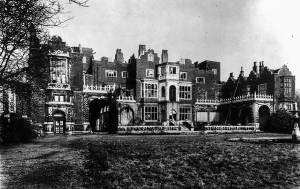
National Archives
Three weeks after the start of the Blitz, three high explosive bombs fell in the grounds, doing minor damage to the House. A few days later, in the night of 27/28 September 1940, a container of incendiary bombs and an oil bomb fell in the centre of the House. A subsequent report that the fire watchers had been distracted by a fire in the estate was indignantly denied by Lord Ilchester in a letter to the Times; his Steward, the ARP Warden, saw the bombs fall and, with his staff, immediately tackled the fire, assisted by the Fire Brigade which arrived within ten minutes of his first report. However, the water pressure failed and the entire centre of the House was gutted before the fire could be brought under control.
Lord Ilchester’s staff tidied up the debris, salvaging the books from the library (later sold at auction in 1947 for a total of £5,280), but nothing was done to protect the ruins from the weather. A member of the Society for the Preservation of Ancient Buildings (SPAB) wrote in 1942 that: “Lord Ilchester has been so stunned by his loss that he inclines to the view that it is irreparable. The spectacle of his beloved home in ruins has induced a kind of fatalistic – even apathetic – state of mind …” Indeed, for the next ten years the ruin was simply allowed to decay.
Most of the external walls of the House remained standing, and the famous photograph of the library shortly after the bombing seemed to show that, apart from the destroyed roof, the structure was in good condition. The organisations with an interest in the House – the SPAB, the War Damage Commission, the Ministry of Works and, from 1947, the Ministry of Town and Country Planning – all started with the view that the building could somehow be saved. But the near total loss of the original Jacobean features in the centre of the House, and the defective state of such Jacobean brickwork as survived, even before the lack of protective works enabled further damage, convinced each organisation in turn that any full reconstruction was not feasible.
In the meantime, Lord Ilchester had been discussing a possible sale to the London County Council. By late 1945, there was tentative agreement on the sum of £715,000. The negotiations stalled, however, over the impact of war damage compensation - whether the amount of such compensation should be the value of the House before the bombing, or the cost of reconstructing it; and whether Lord Ilchester or the LCC should claim it (and therefore take the risk as to how much it would be).

The Town & Country Planning Act 1947, introducing compulsory purchase for the value of the land as it was, introduced a further complication. Backsliding by the LCC, an arbitration and some hard talking behind the scenes resulted in a Private Act of Parliament confirming the sale for £250,000; the Earl was entitled to receive in addition any war damage compensation, although if that took the payment to him above £715,000, the balance would go to the LCC. The sale took effect on 22 May 1952.
Like its predecessors, the LCC first contemplated preserving the structure; the time that it took for this optimism to be displaced, and the slow progress of the difficult and dangerous demolition, gave time for the proposal for a Youth Hostel to take root. This enabled the preservation of the East Wing and the construction of the Youth Hostel was completed in 1957 and is still in use today.
Rowan Freeland
Photos courtesy of National Archives

Rowan is one of the Blue Badge Guides who leads tours covering the history of Holland House and its pleasure grounds. Regular tours will run throughout 2026, led by Rowan or Leila Sukiur. Tour dates are listed under Dates for your Diary, together with booking instructions. The first tour is on Sat. 7 March, which will be the last chance to see the conserved exterior of grade 1 listed Holland House before the terrace closes for the opera season. On 25 April, Rowan will lead a tour on how Holland House survived two world wars.
[February 2026]